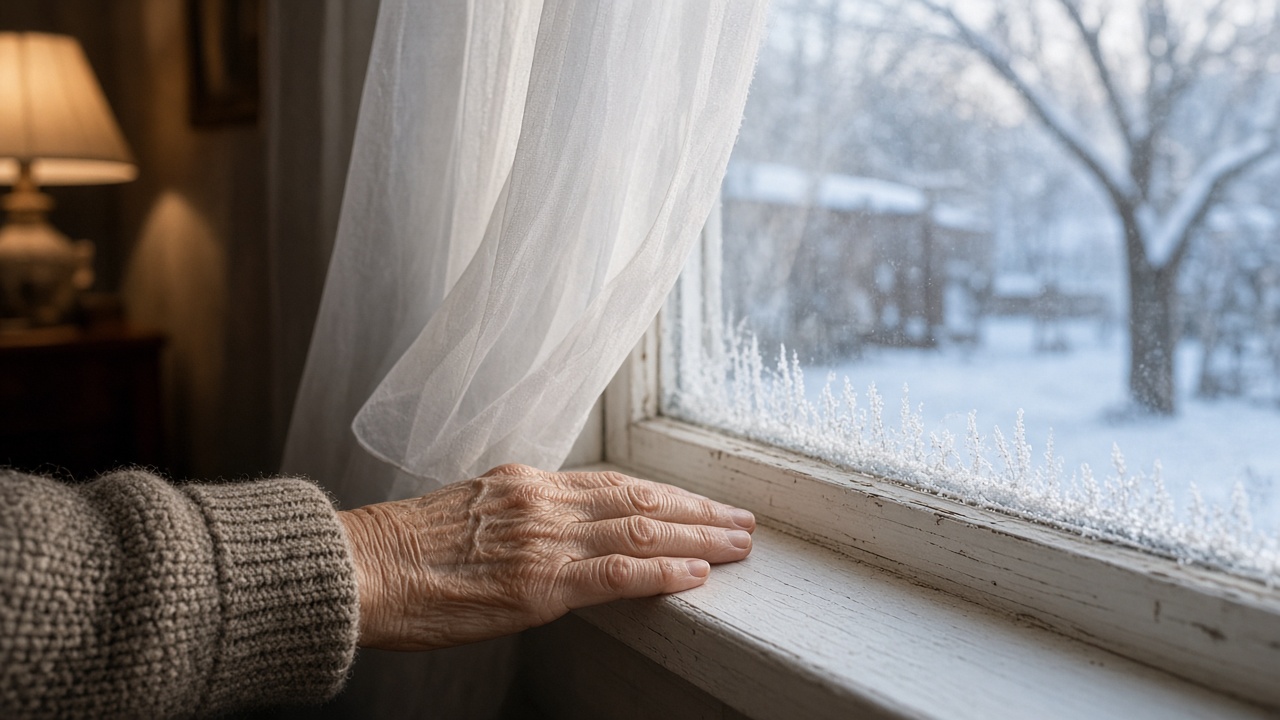
That chill by the window may come from a leak, or from the glass itself. Here’s how to tell the difference.
You know the spot: the chair by the window where you pull a blanket over your knees, even though the thermostat says it’s warm enough. The curtain stirs on a still night, and you wonder what’s getting in.
It may not be what you think. A U.S. Department of Energy (DOE) Building America guide on window performance notes that many people blame drafts on leaky windows when in fact they are the result of cold air patterns initiated by cold window surfaces. Air next to the window is cooled and drops to the floor, then warmer air from the ceiling replaces it and is cooled in turn. The same guide says that with a cold window, you may feel cold in warm clothes in a 70-degree room.
Either way, your windows may be contributing to drafts or heat loss, and the right fix depends on the cause. Heat loss may matter beyond comfort, too. DOE’s federal window purchasing guidance advises: “In cold climates, where space-heating costs are a concern, buy or specify products with a low U-factor to keep heat loss to a minimum.” Here are six ways to find out what’s really going on.
FindMyRenovation
Cold by the window all winter?
Tell FindMyRenovation about your windows and compare quotes from local window pros screened for insurance and reputation. Getting quotes doesn’t obligate you to hire anyone.
Free · Takes about 5 minutes · No obligation to hire anyone
1. Figure out whether it’s a leak or cold glass
DOE’s guide describes two separate winter comfort problems at windows. One is radiant heat loss: your body gives off heat to a cold glass surface, and you feel it most on the side facing the window. The other is that falling curtain of cool air. Air that sneaks through gaps is a separate issue. DOE’s federal purchasing guidance advises keeping windows tightly closed with all latches locked, which it says minimizes uncomfortable drafts.
What to check: Lock every sash and notice whether the chill changes. Then sit near the window and pay attention to where you feel it. Cold on one side of your body, or a slow chill that pools near the floor, may point to the glass. A sharp draft at one corner or joint may point to a leak.
Your move: Get free window quotes from local pros at FindMyRenovation and ask each one which they think you’re dealing with.
2. Read the condensation and frost on the room side
Where moisture forms on the room side of the glass can tell you something. NFRC’s Consumer Guide to Windows explains that condensation forms when the temperature of a window’s interior surface is significantly colder than the air inside. DOE’s guide adds that the bottom edge of the window has the highest risk of condensation, and that with traditional aluminum spacers between the panes, the colder edge is more prone to condensation. The EPA notes that condensation can also be a sign of high indoor humidity, and recommends keeping it below 60 percent, ideally 30 to 50 percent.
What to check: Look for patterns. A band of moisture or frost along the bottom edges may point to cold edges. Fog across the glass in many rooms may point to humidity. DOE warns that over time, excess condensation can damage window parts and surrounding walls and promote mold and mildew.
Your move: Take photos of what you find on a cold morning. They’ll be useful when you compare window quotes through FindMyRenovation.
3. Check what your frames are made of
DOE’s guide says aluminum’s biggest drawback as a frame material is that it conducts heat readily, and in cold climates a simple aluminum frame can get cold enough to collect moisture or frost on its inside surfaces. ENERGY STAR notes that aluminum frames in certified windows typically include thermal breaks to reduce that heat loss, while vinyl, fiberglass, and wood frames provide good insulation.
What to check: Run your hand along the frame on a cold day. If it feels noticeably colder than the wall around it, or frost forms on the frame itself, ask an installer what the frame is made of and whether it has a thermal break.
Your move: Compare window quotes at FindMyRenovation and ask each pro to explain the frame options for your climate.
Window pros near you
Ready for windows that feel warmer?
FindMyRenovation connects homeowners with local pros for energy-efficient window upgrades, whole-home replacements, and custom installations. Answer a few quick questions, then review quotes side by side.
Free · Takes about 5 minutes · No obligation to hire anyone
4. Find the NFRC label, or the paperwork
Windows certified by the National Fenestration Rating Council (NFRC) carry a label with their tested ratings, and ENERGY STAR says it appears on all ENERGY STAR certified windows. The U-factor shows how well the window insulates (lower is better). The solar heat gain coefficient (SHGC) shows how much of the sun’s heat gets through. Air leakage (AL) shows how much air passes through the window’s joints (lower is better). Condensation resistance runs from 0 to 100 (higher means less build-up).
What to check: If the label is gone, look for a manual or the original invoice. When you compare new windows, ask each installer for the NFRC ratings in writing.
Your move: Ask the window pros you find through FindMyRenovation to put the NFRC numbers side by side in each quote.
5. Look up your ENERGY STAR climate zone
“Efficient” depends on where you live. ENERGY STAR says its performance criteria for windows are based on NFRC-certified ratings and vary by climate zone, and that certification is based on U-factor and SHGC. For cold climates, DOE also recommends a low air leakage rating to reduce drafts, and suggests high condensation resistance ratings in extremely cold regions.
What to check: Use ENERGY STAR’s climate zone lookup on its windows criteria page. Then compare any ratings you found in step 4 against the criteria for your zone.
Your move: Request free window quotes at FindMyRenovation and ask whether each window meets the ENERGY STAR criteria for your zone.
6. Get a home energy assessment
Sometimes the window isn’t the main culprit. DOE says a professional home energy assessment often pairs a blower door test, which lowers the air pressure inside so outside air flows in through gaps, with an infrared scan. When the two are done together, air leaks show up as black streaks in the infrared image. The report may show you only need to seal small gaps and add attic insulation, or that bigger upgrades may make sense.
What to check: DOE suggests finding a certified assessor through your electric or gas utility or your state or local energy or weatherization office, and making a list of problems like condensation and drafty rooms before the visit. It also notes that DOE’s Weatherization Assistance Program funds states to help low-income families weatherize.
Your move: If the assessment points to your windows, compare quotes from local window pros through FindMyRenovation.
What to have handy before you request quotes
- Your draft notes: which rooms feel cold, and when
- Photos: of condensation or frost on a cold morning
- Window paperwork: NFRC labels, manuals, or invoices, if you have them
- Your climate zone: from ENERGY STAR’s lookup
- Window count: how many windows you want quoted, and where they are
- Assessment report: if you’ve had one
Bottom line
A cold room in winter doesn’t always mean a leaky window. It may be cold glass, cold frames, high humidity, or gaps somewhere else in the house. Figure out which, and you’ll know what kind of fix to ask about. A little detective work may make for a better conversation with a pro.
Get free, no-obligation window quotes from local pros at FindMyRenovation.
Your winter window checklist
Find out what’s behind the chill.
- ✓ Lock every sash
- ✓ Photograph the condensation
- ✓ Find your NFRC ratings
- ☐ Compare quotes from local pros
Compare quotes from local window pros screened for insurance and reputation.
Free · Takes about 5 minutes · No obligation to hire anyone
Disclaimer: FindMyRenovation.com is operated by Click Circle LLC. FindMyRenovation is a marketing and lead-generation platform, not a home service provider or home improvement company, and it does not perform, supervise, or guarantee any renovation work. The service is free to use because some of the home service providers it matches you with pay it a referral fee or commission when you click on their offer, submit a request, or take another qualifying action. That compensation may influence the order in which providers are presented, and not all available providers are included in its network. See our full Advertiser Disclosure. Providers matched to your project may contact you to discuss your quote. Any provider you are matched with is an independent third party, and actual pricing, timelines, and availability depend on that provider and your project. It is your responsibility to verify that any provider carries the insurance required for the work and to review all terms before signing an agreement or making a payment. This article is for general educational purposes only and is not personalized construction, design, energy, financial, or legal advice. Sources: U.S. Department of Energy (DOE), ENERGY STAR, the National Fenestration Rating Council (NFRC), and the U.S. Environmental Protection Agency (EPA).